12 weeks (June-August 2025)
Improving early assessment of Mental Health
Navigating the healthy emotional landscape
of mental health conditions begin before age 14, yet most remain undetected until much later.
higher risk of major depressive disorder when early symptoms go untreated
increased risk of cardiovascular disease from prolonged mental stress and untreated conditions
Most AI mental health apps today are built around the Companion Model, where users log moods, track thoughts, and interact with an AI chatbot.
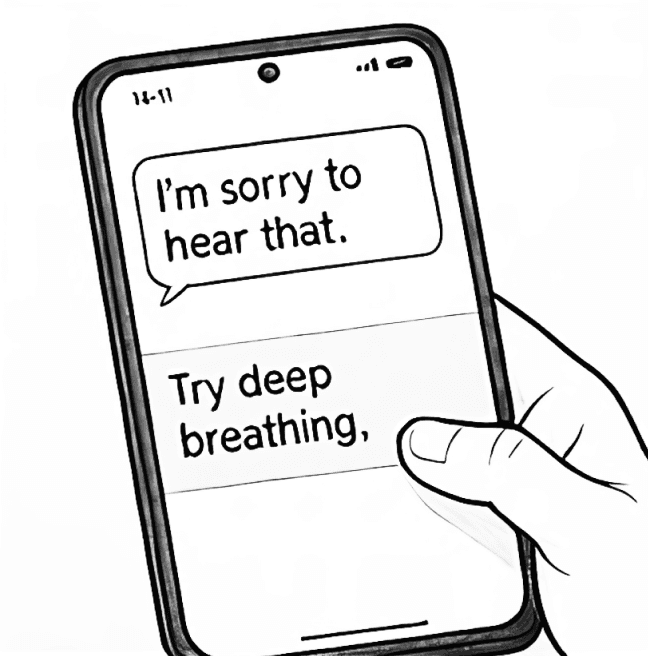
Responses are often one-size-fits-all, offering generic solutions rather than tailored guidance.
Apps fail to remember past conversations, making users repeat their concerns.
Chatbots lack empathy, leading users to feel unheard and disconnected.
Focus remains on symptom logging, not proactive screening for early warning signs.
How can I help users of AI mental health apps
who struggle with poor early assessment to feel heard, understood, and supported
while proactive screening of their mental health?
THE HIGH-LEVEL GOALS that defined my design
Build deeper emotional connections
Understand their emotional journey
Offer relevant, personalized support at the preliminary stage.
Individuals seeking mental health support
need a system that builds deeper emotional connections, understand their emotional journey and offer relevant personalized support
to assess their mental health at preliminary state.
Build Deeper Emotional Connections
Trust is the first step. If users feel genuinely heard and cared for, they’ll open up sooner about what they’re going through. That makes it easier to spot early warning signs and also helps them feel a stronger bond with the app.
Understand the Emotional Journey
It’s not just about logging moods — it’s about connecting the dots. When users can see their patterns, progress, and milestones, it reassures them that their journey is being noticed. This makes spotting small shifts in mental health much clearer.
Assessing the early signs of mental health decline with Feelscape
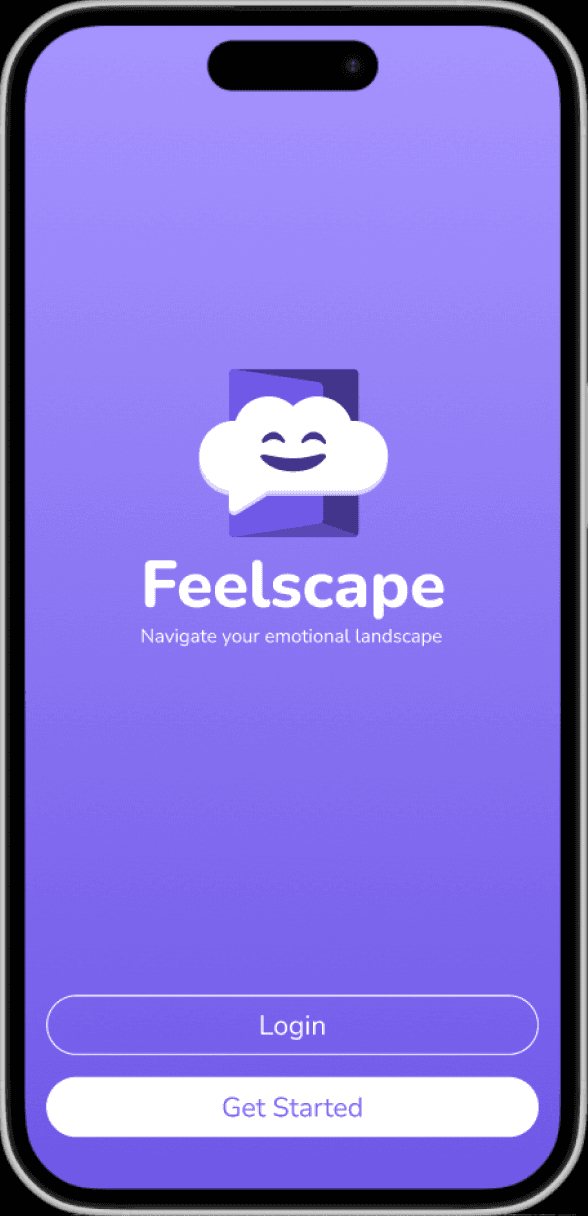
Feelscape is an AI-driven mental health support system that helps people detect early signs of declining mental health. With empathetic, context-aware support, it ensures users feel heard and guided before challenges become overwhelming.
Offer Relevant, Personalized Support
Support has to feel personal. By giving users the right activities, useful insights, and quick access to a therapist if needed, the app makes sure they don’t just get generic advice — they get the kind of help that actually makes a difference.
The 3-Layer Solution Framework
The 3 layers — Empathize, Understand, Support — are important to effective early mental health assessment. Empathy builds trust so users feel safe to share. Understanding ensures their emotional journey is recognized and contextualized. Support provides timely, personalized help, turning early signs into actionable care. Together, these layers create a foundation for meaningful intervention before problems escalate.
Synthesizing the Insights
Synthesizing the Insights
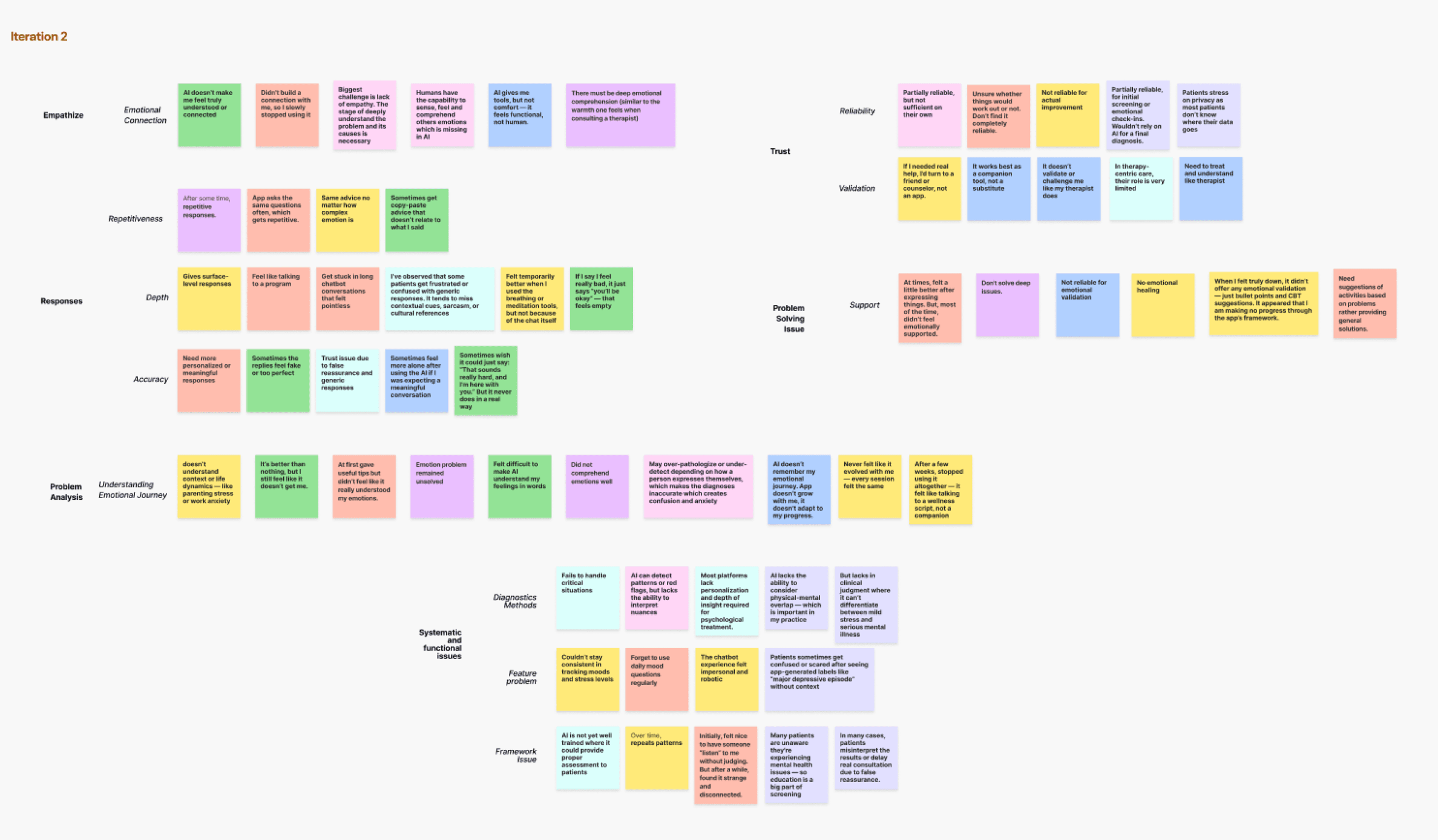
All the findings are clustered into themes to analyze further in the project
These themes form the foundation of effective mental health assessment and are interconnected. Addressing them is key to enabling accurate, supportive evaluation at early stages of mental health decline.
To validate the problem at larger scale, I surveyed 36 participants, belonging to different age group between 18 to 60 years. This helped to validate the problems identified at larger scale and scope out the key concerns of the users.
Creating the brand: Feels emotionally connected and supported
Taking inspiration from the idea of emotions as landscapes, I designed a system that feels both modern and empathetic. The vibrant Neon Violet signals urgency and focus, while the softer Aqua Glow offers balance and reassurance—together creating a dynamic but supportive environment.
The font Nunito, with its rounded letterforms, adds warmth and approachability while balancing professionalism with empathy—an essential quality for mental health support.
The copy tone complements this by being understanding, supportive, and non-intrusive, ensuring that users feel reassured while engaging with their emotions.
While brainstorming, I had many ideas for the app, but not all were practical or impactful. Using an Impact–Effort Matrix, I mapped each idea by user value and implementation effort. This helped me prioritize meaningful, feasible solutions—keeping the design both empathetic and realistic.
At times, I asked myself whether the solutions truly addressed the root cause of poor early assessment through building deeper emotional connection, understanding emotional journey and providing personalized support. While I iterated on screening and assessment flows, I now realize that involving a wider range of users and stakeholders earlier would have uncovered deeper insights. More structured testing and faster feedback loops could have improved the realism of the solutions, especially in balancing AI-driven support with professional involvement. This project taught me to embrace ambiguity, stay confident in my ideas, and continuously refine through iteration.
Looking ahead, my goal is to refine the app into a more empathetic and reliable for users. While the current design lays the foundation for emotional connection and basic support, the next phase will focus on enhancing personalization, integrating professional help more seamlessly, and smarter use of AI to detect and respond to mental health patterns. By combining user feedback, expert collaboration, and continuous iteration, I plan to evolve the app into a tool that not only supports users in the moment but also guides them toward long-term mental wellbeing.
What could’ve been done better
Understand user’s mental health management
Assessment of mental health in AI based health apps
Behavior and experiences of users
Age- 18 to 60 years
Currently seeking mental health assessment or previously have been under professional care
Active and former users of digital mental health apps based on AI
Includes users from Urban and Semi Urban settings
HMW create a system that helps users feel genuinely heard and emotionally connected during their mental health journey?
HMW detect and reflect early signs of mental health decline in a way that feels supportive and non-intrusive?
HMW provide personalized and relevant support that adapts to each user’s unique emotional context and progress?
Building Emotional Connection
Personalized, Relevant Support
Understanding Emotional Journey
Late detection of signs, Delay in Action & Need for Proactive nudges
Most people don’t realize when their mental health starts declining.
Early assessment of the cases can help individuals catch the
signs early and prevent countless struggles.
Placing a mood log on the home screen was a conscious choice to build trust. When people track their feelings regularly, they get a clearer sense of what’s happening with their emotional state and can spot changes early.
Comprehensive Mood Tracker
The comprehensive mood tracker goes beyond simple labels like “good” or “bad.” By logging their feelings regularly, users gain deeper awareness of their emotional patterns. With an intensity slider to show how strongly they feel, a predefined list of emotions for easy expression, and context factors captures a fuller picture of what shapes their mood.
The interactive empathetic AI avatar makes conversations feel human by showing expressions that match the chat context. This friendly presence helps users feel listened to and cared for, which builds trust and makes it easier for them to open up.
Community Success Metrics
Community Success Metrics show users that others with similar struggles have found certain activities helpful. By sharing stats like “89% felt less stressed after this,” the app builds trust and reassurance, helping users feel less alone and more motivated to engage.
Detailed Emotional Insights by AI
The AI-powered insights turn mood logs into a clear story of patterns, progress, and what truly helps, giving users both clarity and motivation to keep going.
Setting activity goals makes the journey feel more structured and motivating. It helps users see progress over time while also giving the AI context to offer better insights and support along the way.
Past Interaction Relevance
Past Interaction Relevance makes the AI feel more human by remembering what users have shared before- their moods, struggles, and progress. Instead of starting fresh each time, the AI can connect the dots, like reminding them of last week’s stress or a goal they set.
Milestone Achievements & Badges
Milestone achievements and badges celebrate small wins that often go unnoticed in mental health journeys. They motivate users to stay consistent, remind them that progress is happening, and make their growth feel more visible and meaningful.
AI-curated activities give users timely, personalized suggestions based on their moods and triggers. Instead of generic advice, the app recommends what actually fits their situation, helping them take the right step toward feeling better.
It gives users the freedom to self-explore by choosing activities based on how they feel in the moment. It adds flexibility, helping them find what suits their mood best instead of only relying on AI suggestions.
The Daily Health Summary gives users quick, short-term insights like mood entries, activity goals, and small wins. By showing progress in real time, it keeps them motivated and encourages them to return to the app every day.
Connect to a Professional Therapist
AI has its limits — it can’t replace real diagnosis or treatment. That’s why “Find Therapist” is an option to connect directly with a professional therapist. The AI can be a supportive guide for daily struggles, but when it notices patterns that may need deeper attention, it gently nudges users toward expert help.
Understanding the problem
I conducted in-depth interviews and surveys to explore how users currently manage their mental health and what role they expect AI platforms to play in supporting them. The goal was to uncover not only practical needs- like reliability in screening and assessment, but also emotional pain points users face when interacting with AI-based mental health apps.
Biggest challenge is lack of empathy. To have deep understanding of the problem and its causes is necessary
At times, felt a little better after expressing things.
But, most of the time, didn’t feel emotionally supported.
AI doesn’t remember my emotional journey. App doesn’t grow with me, it doesn’t adapt to my progress.
Stage-4 (Physical/Mental Strain)
Stage-3 (Noticeable Impact)
Stage-3 (Noticeable Impact)
Conclusion: People recognize issues late and act delay action, highlighting the need for proactive nudges.
Stage-4 (Physical/Mental Strain)
Coping Mechanisms and Support
Most common coping strategies when feeling stressed or anxious
For mental health support, people overwhelmingly first turn to
Talking to friends/family
Meditation or physical activity
Handle problem on their own
Perception of Support and Relevance
Emotional Connection is Crucial
Felt “Heard & Understood” as
or understood when talking about their emotions on the app.
Generic & flat responses= 63.3%
Lack of genuine human empathy or emotional connection= 53.3%
Robotic and repetitive responses = 46.7%
Primary problems identified were:
No Personalized coping exercises= 21 out of 36
Generic/irrelevant recommendations= 14 out of 36
Improper personal progress tracking= 14 out of 36
felt the app's support was not relevant to
their specific situation.
The insights from the survey and interview helped in understanding the frequency and severity of the problem. This statistically provided clearer picture of the pain points of the mental health app users.
Following the insights I prepared the How Might We, which led to the high-level objectives that guided my design of Feelscape.
Emotional Support (AI Chat)
Emotional Connect (Empathy)
Integration (Health/Wellness)
THE APP IS:
Designed to support mental wellbeing by providing guidance and encouragement.
Focused on building emotional connection and offering personalized support.
Intended to help users reflect, track progress, and stay motivated.
Meant to foster a sense of belonging through collective wellbeing trends, while maintaining privacy.
THE APP IS NOT:
A replacement for professional mental health treatment or therapy.
A tool for diagnosing or prescribing medications.
Focused on tracking every symptom or problem in detail.
I felt it is important to set some key principles that will guide all the design and product decisions for Feelscape. This ensures alignment with the app’s scope and maintain a consistent user experience.
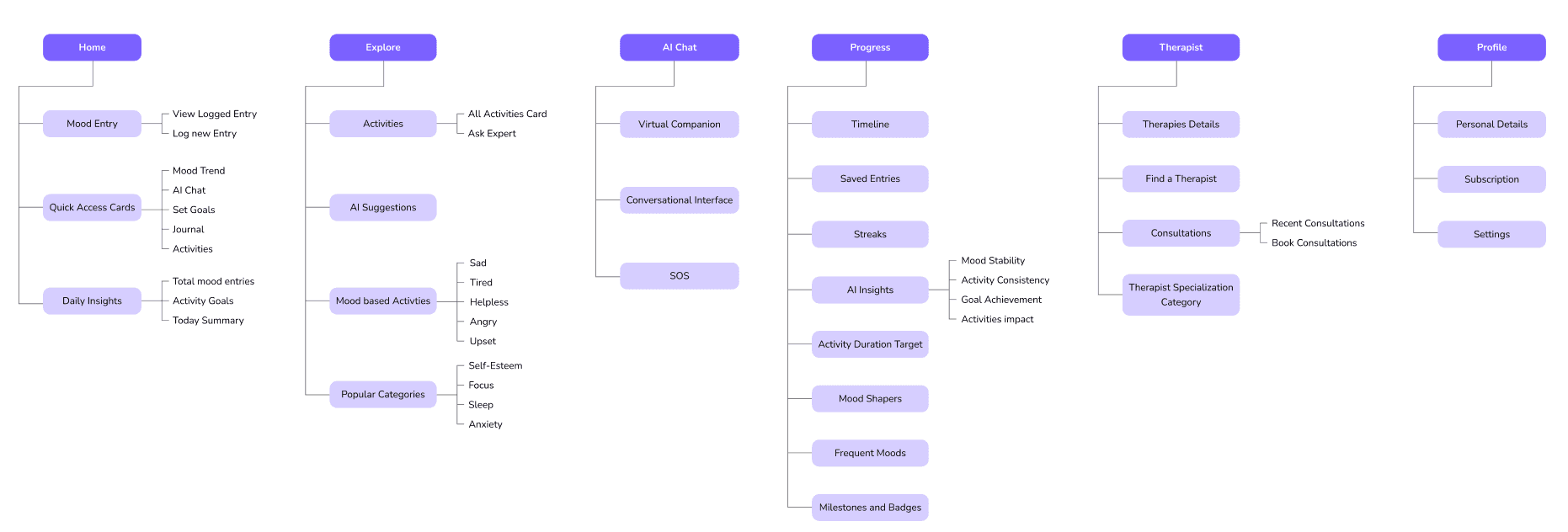
To form the structure of the app, I created an Information Architecture that organizes features in a clear, intuitive flow. It ensured users could easily navigate, discover key functions, and complete their goals without confusion—laying the foundation for a seamless experience.
Empathetic Understanding
AI must recognize emotional cues (expressions, behaviors, patterns) and respond with compassion—ensuring users feel heard and understood, not judged.
Guided Professional Support
When high-severity signals emerge, AI must recognize the limits of self-help and gently recommend professional intervention—providing users with safe, timely pathways to therapists, counselors, or crisis support.
Connected Progress
AI should monitor both individual and community wellbeing, celebrating shared growth to keep users motivated. By highlighting others’ progress, it reinforces hope, encourages consistency, and fosters a sense of belonging without compromising privacy.
Personal Flexibility
Users should be able to move seamlessly between check-ins, journaling, mood tracking, and guided reflections—without friction or losing context.
The importance of emotional depth in design
I realized that designing for mental health goes beyond solving functional pain points. Emotional alignment- making users feel safe, heard & motivated is often the real challenge.
The Value of Iteration in the design
I learnt that solutions rarely work perfectly in the first attempt. Iteration and testing are what helped refine the experience, uncover blind spots, and bring real user needs to the surface.
Balance between AI and human support
I learnt that AI cannot be a replacement for human connection. Instead, the best solutions is to find the right balance- AI for accessibility and consistency, humans for depth and care.
Collaboration with the right voices matters
Bringing in and interviewing mental health professionals early and testing with a diverse group of users showed me that how critical it is to combine perspectives for a more balanced solution.
User is under constant stress & feeling drained
Even after multiple interactions, user repeats his feelings
The app can’t recall the context of past interactions
The app didn’t alert and help the user even after frequent breakdowns
User felt frustrated and helpless about the situation
He closes the app and chose not to take any help
User failed to take action upon his condition which led to severe problems
He downloads a mental health app for support
He shared his feelings and expected human like support from the app
But, the app responses felt robotic and disconnected to the user
The app recommended an activity to the user
However, he felt the activity to be inappropriate & unhelpful
During testing, users reported difficulty locating core features such as mood trends, AI chat, goal setting, journaling, and activities. While not impossible to find, these options required multiple clicks and were not immediately visible, causing friction in navigation.
Users were confused about the mood entry’s date. This created uncertainty about when a specific entry was recorded. They struggled to access past interactions and previous mood logs, since no dedicated functionality or screen existed for reviewing history.
Onboarding Progress Indication
During onboarding, users felt the process was too long and uncertain, as they had no visibility into how many questions remained. The users had no option to skip any onboarding question. This lack of clarity led to frustration and disengagement.
I introduced quick-access shortcuts on the home screen, making core features instantly available. This reduced the number of clicks, improved discoverability, and allowed users to better engage with the app.
I added a calendar strip which indicates the creation date. Also, users can easily navigate to previous entries. This enabled self-reflection and progress tracking, helping users better understand their emotional patterns.
To address this, I introduced a progress indicator that visually shows users their position in the onboarding flow. This helped users track their progress, understand how many steps were left, and feel more in control of the process.